A bubble-tea ingredient can appear lower in sugar simply because its label uses a smaller serving. Another can list both total sugars and added sugars even though those numbers should not be added together. Before comparing cartons, syrups, or pearl kits, put the labels on the same basis.
This guide uses U.S. Nutrition Facts terminology and hypothetical numbers to explain the arithmetic. It does not estimate the nutrition of an unnamed cafe drink or promise a health outcome. Your package, the amount you actually use, and any preparation instructions determine the useful comparison.
Two sugar lines are not two separate piles
FDA explains that total sugars includes both naturally occurring sugars and added sugars. The added-sugars line sits within that total. If a serving lists 12 grams of total sugars and includes 7 grams of added sugars, the total remains 12 grams. It is not 19 grams.
For comparison purposes, write the two figures in separate columns rather than summing them. One column answers how much total sugar the label reports; the other identifies how much is classified as added. Naturally occurring sugar in milk can contribute to the first column without belonging in the second.
This distinction matters when comparing plain dairy milk with a sweetened plant beverage, flavored creamer, or condensed milk. A product with no added sugar need not have zero total sugar. Conversely, a smaller serving of a heavily sweetened product can show fewer grams on the label than a much larger serving of another product.
Read the ingredient list alongside the nutrition panel. It can help identify what the product contains, but it does not supply the missing quantity for each ingredient. Do not infer an exact number of sugar grams from the order of ingredients or from words such as natural, original, premium, or barista.
Find the denominator before comparing
The denominator is the amount of product to which the number applies: perhaps 15 milliliters of syrup, 240 milliliters of beverage, or 30 grams of dry powder. Circle that amount first. Then check whether the panel describes the product as sold or after preparation.
FDA notes that serving size reflects amounts people typically consume rather than a recommendation for how much to eat or drink. A bottle may contain multiple servings, and some labels provide both per-serving and per-package columns. Choose the column that matches your calculation instead of counting the whole bottle as one serving automatically.
Use this formula: sugar in your portion equals label sugar multiplied by your portion amount, divided by the labeled serving amount. Keep the units consistent. Milliliters can be compared with milliliters and grams with grams. Do not silently treat a tablespoon of thick syrup as a tablespoon's weight in grams.
Suppose Beverage A lists 8 grams of total sugars per 240 milliliters and Beverage B lists 5 grams per 100 milliliters. For the same 120-milliliter pour, A contributes 4 grams and B contributes 6 grams. B's smaller printed number does not make it the lower-sugar choice for that equal volume.
To compare shopping options independently of your recipe, normalize both to 100 milliliters or 100 grams, depending on the product. To plan a cup, normalize to the amount you will actually use. Those are different questions, so keep both results labeled rather than using a shopping comparison as the finished-drink total.
Build a cup ledger from ingredients you measure
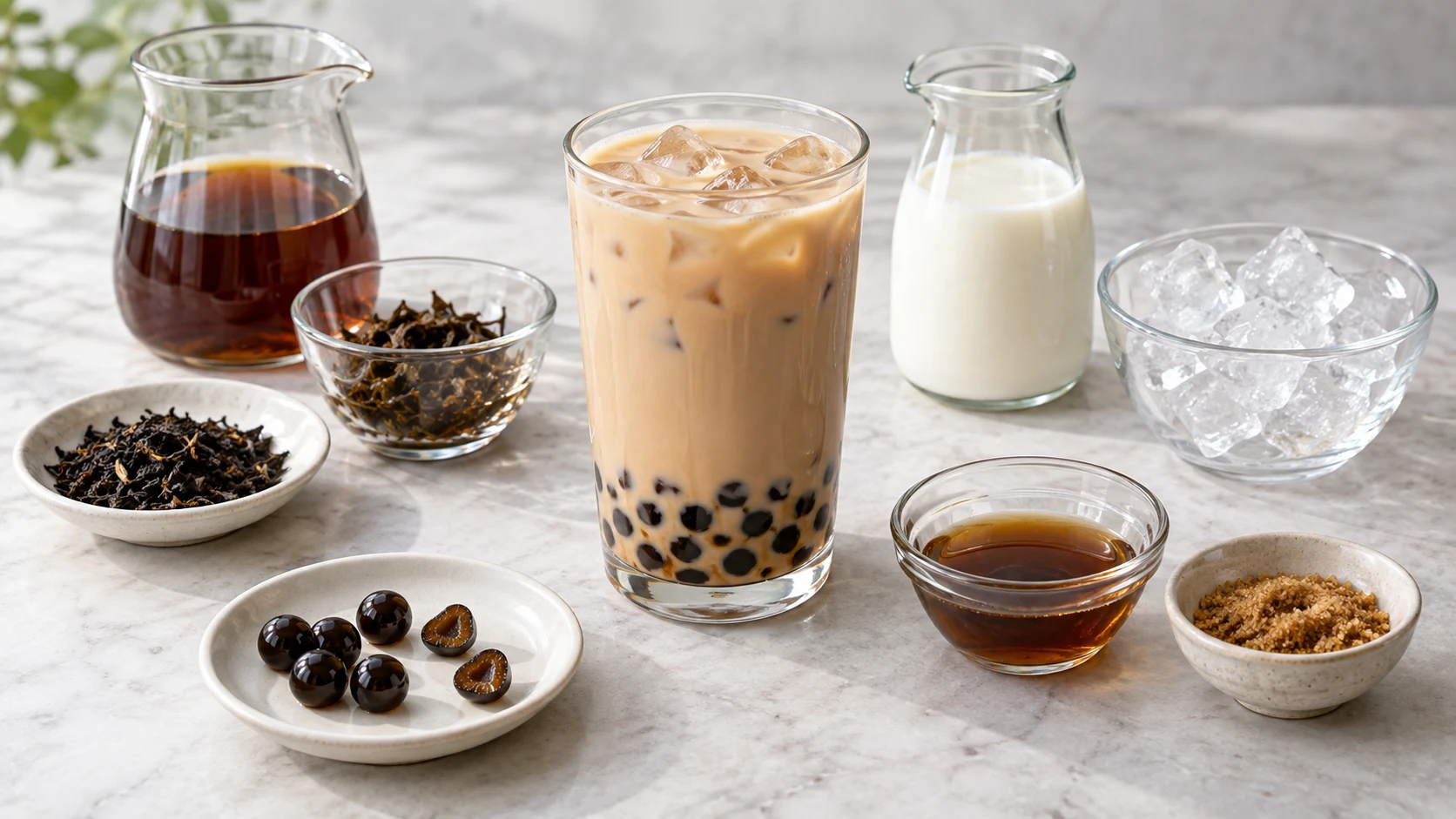
List every sugar-bearing ingredient once. For a simple milk tea, the rows might be milk, syrup, prepared pearls, and an optional flavored powder. Plain water and ice add no sugar, but adding them changes concentration and final volume. A diluted cup can taste less sweet while containing the same total grams if you drink it all.
Here is an invented three-row example. Milk contributes 6 grams of total sugars and zero added sugars in the measured pour. Syrup contributes 8 grams of total sugars, all added. The labeled ready-to-eat pearl portion contributes 5 grams of total sugars, including 4 added. The cup totals are 19 grams of total sugars and 12 grams of added sugars.
The arithmetic works because each row describes what actually enters the cup. It would stop being reliable if the pearl label referred to dry pearls while you entered a cooked weight, or if you used a larger syrup spoon than the one measured. Write the basis next to each row so you can spot these mismatches.
For a shared batch, add ingredient contributions for the full batch and divide by the number of equal portions. If the portions are unequal, dividing by the number of glasses alone will not describe every glass. Measure the liquid portions and distribute toppings consistently, or present the result only as a batch estimate.
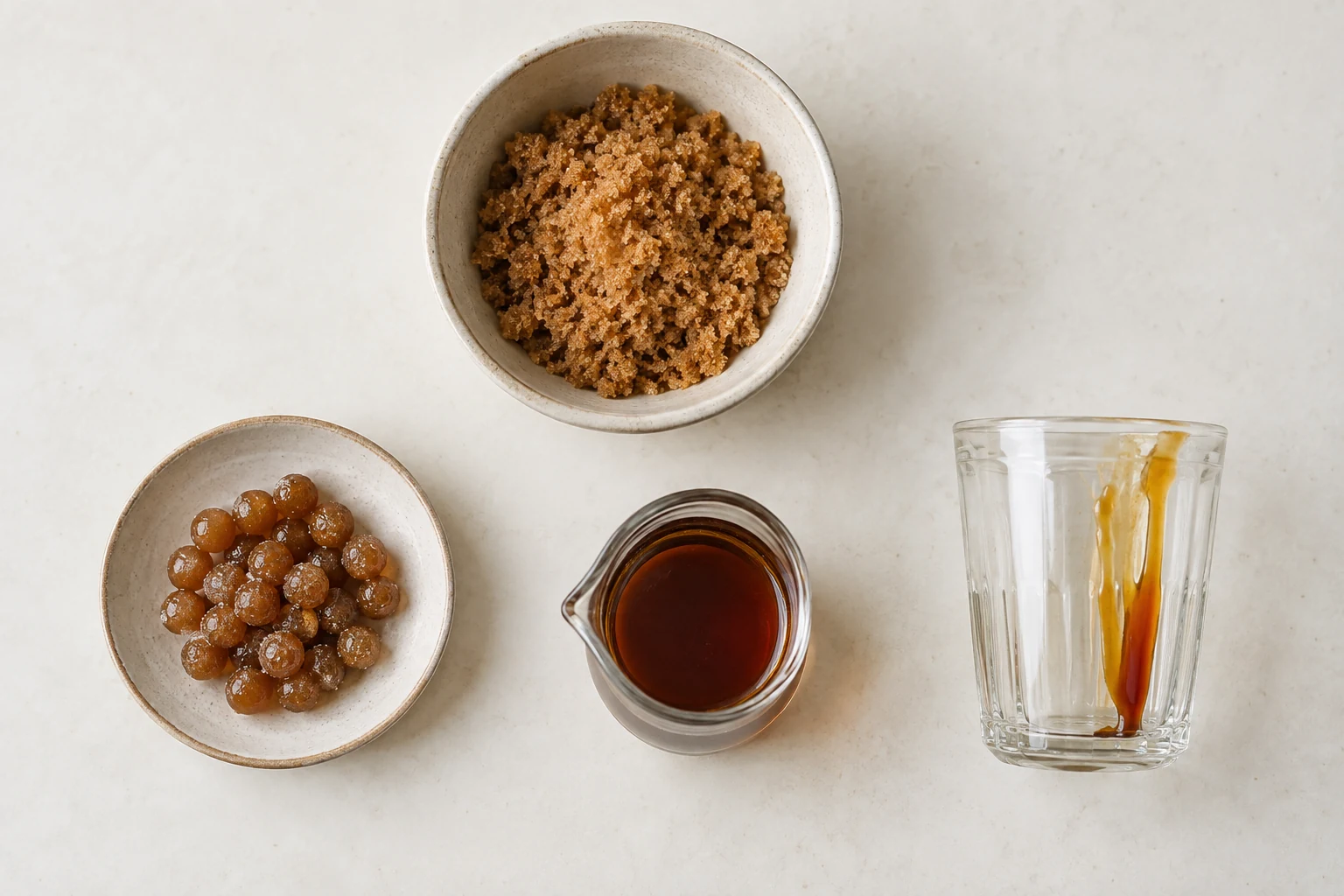
Do not add the nutrition of a prepared kit to the nutrition of all the ingredients already included in that kit. For example, if the supplied panel covers pearls and their syrup together, adding a separate estimate for that same syrup counts it twice. Additional syrup you pour in yourself needs its own row.
Know where the estimate stops
Cooking and draining pearls complicates a home calculation. Some syrup may remain in the bowl, and a serving spoon may transfer different amounts each time. If you need a reproducible comparison, use the same preparation and draining method, while acknowledging that a label-based estimate is not a laboratory measurement.
Nutrition labels also use rounding. Multiplying rounded values can create an answer with more decimal places than the inputs justify. Report sensible approximate grams instead of a result such as 18.347 grams that implies precision you do not have. Retain the underlying portions so the calculation remains understandable.
A cafe's sweetness percentage is not automatically a percentage reduction in the total sugar of the whole drink. Without the shop's recipe or nutrition information, you cannot know which ingredients the adjustment covers. Ask whether it affects only the added syrup and whether toppings or milk are already sweetened.
Use the comparison to make one choice
Choose the change that answers your actual goal. You might compare two milks at the same pour size, reduce the measured syrup portion, or use fewer sweetened toppings. Recalculate that changed row while keeping the others fixed. This shows what the swap changes without pretending it transforms the entire nutritional profile.
Save a photograph of the current panel with your recipe notes and check it when you buy a replacement. Formulations and serving sizes can change. The most useful record is a short ledger with product identity, label basis, actual portion, and calculated contribution, not a permanent sugar number detached from the ingredients.
Sources
- Added Sugars on the Nutrition Facts Label — U.S. Food and Drug Administration
- Serving Size on the Nutrition Facts Label — U.S. Food and Drug Administration