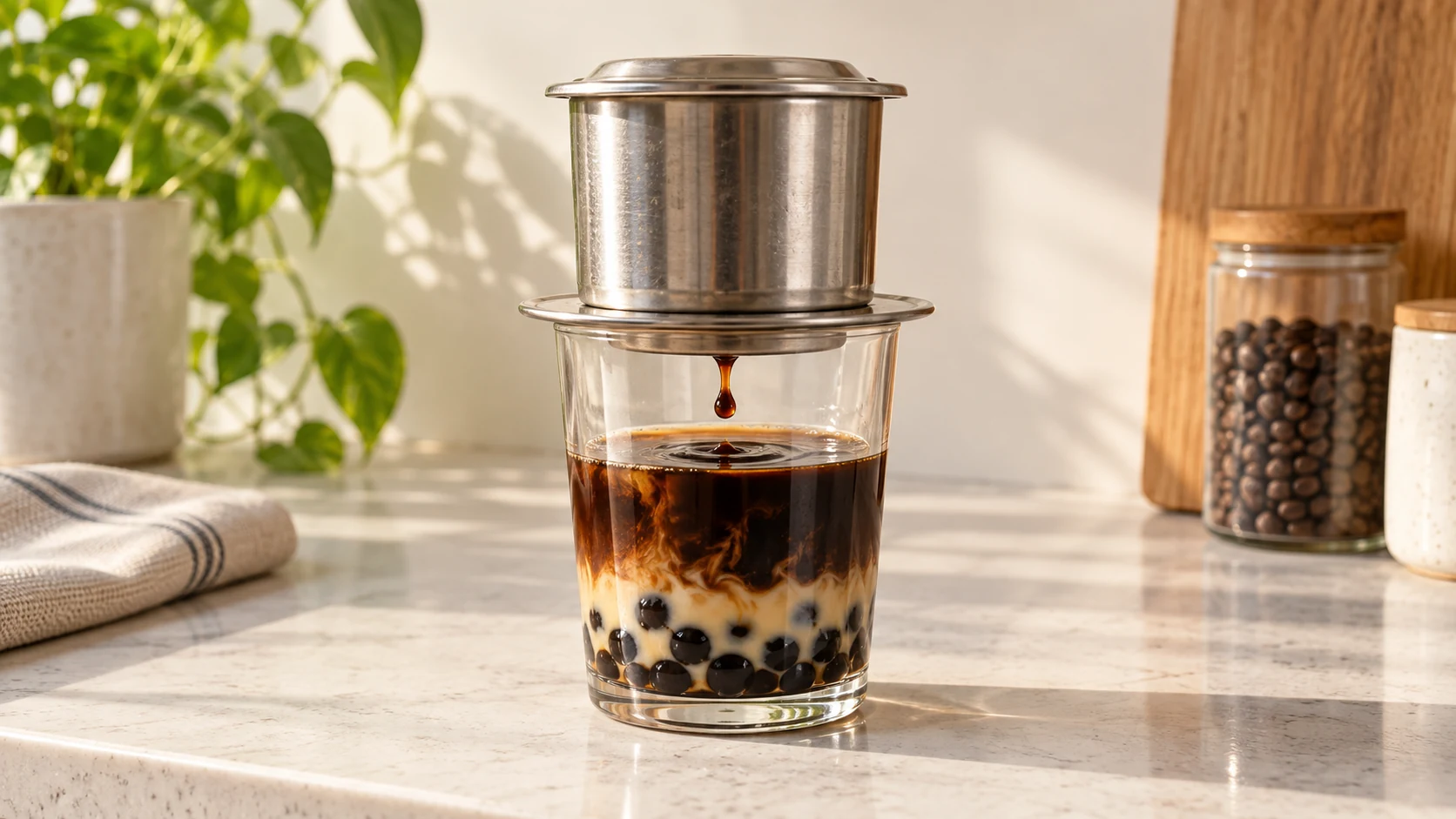
Decaf coffee boba starts with a simple substitution: replace the coffee with a decaffeinated product while keeping track of what else goes into the cup. The substitution preserves a coffee-based drink, but it does not make the drink caffeine-free. Tea, matcha, chocolate, or a regular espresso addition can also change the caffeine picture.
This guide is for choosing and assembling a decaf version of coffee boba. It is not a claim that a particular caffeine amount is suitable for you, and the suggested drink proportions are starting points rather than a tested recipe. If you need to avoid caffeine completely, “decaf” by itself is not the assurance to rely on.
Read decaf as a process description
The FDA states that decaffeinated coffee still contains caffeine and gives a typical range of 2 to 15 mg in an eight-fluid-ounce cup. That range is a general reference, not a measurement of a homemade concentrate, espresso shot, instant mixture, or finished boba. Do not assign its low end to your drink because the package says decaf.
The Coffee Association of Canada describes decaffeination as treatment of green coffee beans before roasting, with different processes using agents such as water or carbon dioxide. A named process may answer a purchasing preference, but it does not tell you the exact caffeine content of the portion you will brew. Keep process claims separate from serving information.
Look for “decaffeinated” or “decaf” on the actual coffee product. “Mild,” “smooth,” a light-colored roast, or a small cup is not an equivalent label. If the product is a premixed latte powder, read the full ingredient list and preparation directions rather than assuming its coffee component is decaffeinated.
For a strict caffeine constraint, ask the producer whether it provides information for the exact product and preparation you use. Even a dry-product number needs an appropriate serving calculation. The FDA also notes that individual caffeine sensitivity varies, so a general adult reference should not be repurposed as a personal guarantee.
Choose the coffee format you can repeat
Decaf beans or ground coffee let you keep your usual brewer. Start with the coffee maker's and producer's recommended preparation, then record the brewed amount you actually collect. If you use a phin, select an appropriate grind and follow its usual method; the site's Vietnamese coffee boba guide covers that separate brewing task.
Decaf instant coffee can be convenient for a small drink because the powder is easy to portion and there are no grounds to strain. Follow its label for the starting amount of water. Increasing the powder changes both coffee intensity and the quantity of product in the serving, so do not treat it as a flavor-only adjustment when caffeine reduction is your reason for choosing decaf.
A ready-to-drink decaf coffee is another option when its ingredient list and storage instructions suit the drink. Check whether it is already sweetened or contains milk. Adding the usual syrup and milk to a premixed product can duplicate components you intended to control separately.
Whichever format you choose, keep regular and decaf containers clearly distinguished. If you share equipment or a kitchen, label the prepared base as well. This is especially useful when preparing several drinks together: appearance alone may not identify which pitcher contains the decaf coffee.
Build one cup around a known portion
Choose your coffee portion first, then fit milk, sweetener, pearls, and ice around it. For a hypothetical starting drink, consider 100 mL of cooled decaf coffee, 100 mL of milk, and a small measured sweetener addition. This is an assembly framework, not a claim of optimal flavor or a measured caffeine value.
Prepare the pearls according to their package instructions and portion them into a cup with enough space for the planned liquids and ice. Measure any syrup that comes with them as part of the sweetening choice. Stir the coffee, milk, and selected sweetener separately, taste a small amount, and pour over the pearls before adding serving ice.
If you choose sweetened condensed milk, begin with less additional syrup, or omit that extra syrup until tasting. If you choose an unsweetened milk alternative, inspect its label and judge the finished mixture on its own terms. Replacing milk does not require changing the coffee portion, though you may prefer a different balance.
Keep additions modest while selecting the base. Brown sugar, vanilla, or a flavored creamer can be explored later, one at a time. Starting with several flavorings makes it difficult to know whether an adjustment improved the coffee balance or simply covered it.
Change intensity without losing the decaf brief
If the drink seems too milky, first consider reducing milk while retaining the chosen coffee serving. If it seems diluted after ice, compare the same base cooled before assembly. Both changes let you investigate balance without automatically adding more coffee product. They may produce a smaller drink, so use an appropriate cup rather than topping it back up randomly.
If you do increase the decaf coffee portion, record that as a larger coffee serving. Decaffeination does not make serving size irrelevant. A double portion cannot be assumed to have the same residual caffeine as the original portion, even if you cannot calculate an exact total.
A half-regular, half-decaf blend is a different choice from an all-decaf coffee base. Adding black tea or matcha also changes the drink into a mixed caffeine-source beverage. Chocolate and cocoa ingredients deserve a label check as well. A garnish or flavor addition should not quietly defeat the constraint that led you to select decaf.
Serve and label the finished drink plainly
For guests, describe it as “boba made with decaf coffee,” and disclose any additional tea or chocolate. Avoid “caffeine-free” unless the entire drink can legitimately support that claim. Keep the coffee package available if someone wants to inspect it instead of giving an unsupported caffeine estimate.
Once milk and other perishable ingredients are added, handle the drink as perishable. FDA guidance calls for refrigeration within two hours, or one hour when the temperature is above 90°F, with a refrigerator at 40°F or below. Follow any stricter ingredient instructions and prepare pearls according to their own directions. These general limits do not establish a storage life for assembled boba.
A repeatable decaf version needs a short record: exact coffee product, preparation, coffee portion, milk, sweetener, and extra flavorings. That record keeps the label meaning intact while you adjust taste. You can then change the balance deliberately without mistaking a familiar coffee flavor for proof that the drink contains no caffeine.
Sources
- Spilling the Beans: How Much Caffeine is Too Much? U.S. Food and Drug Administration
- Decaffeination Coffee Association of Canada
- Are You Storing Food Safely? U.S. Food and Drug Administration